Business system
Reference buildProvision Fulfilment
A fulfilment system for a supermarket: picking, substitutions, delivery slots and stockroom counts as one operation.
- Dated
- 2024
- Product type
- Business system
- Technologies
- 4
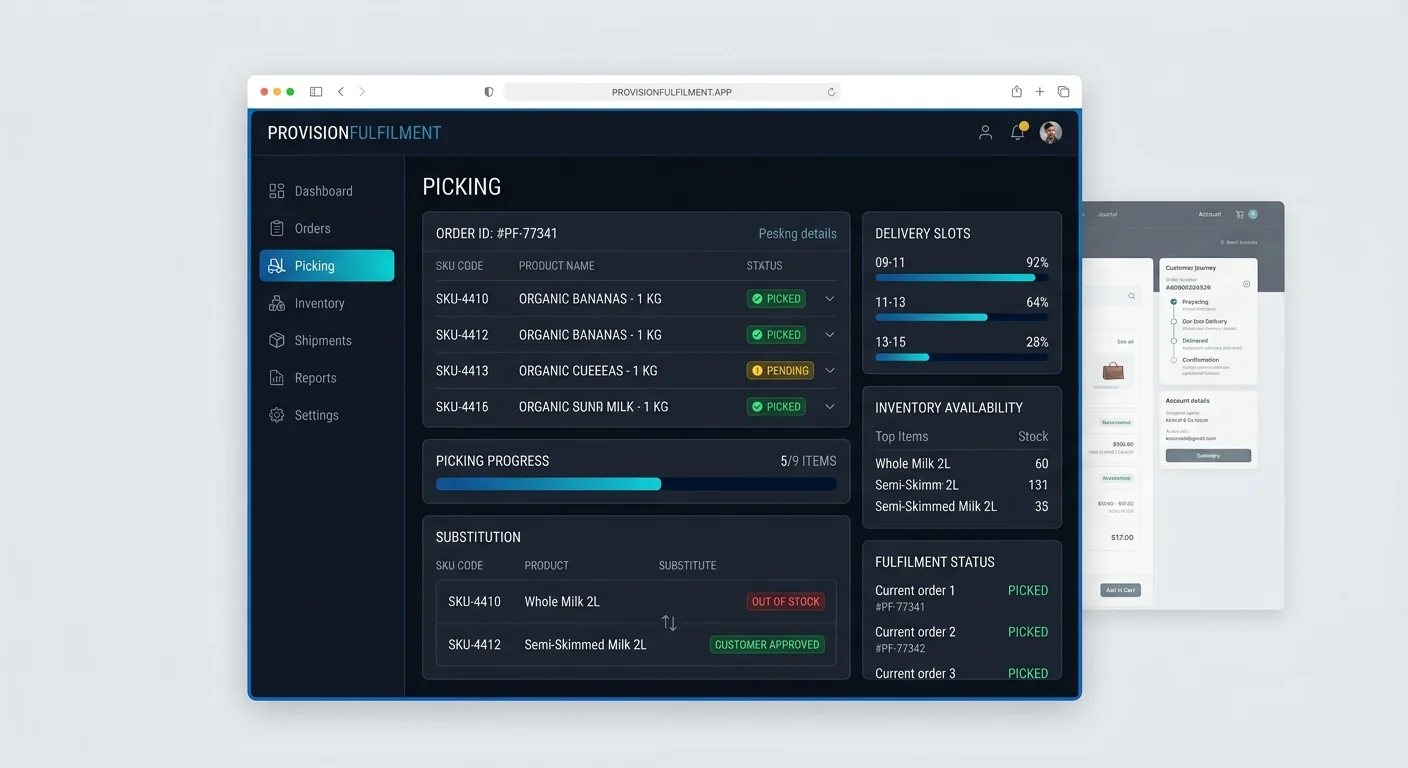
The system, across devices
The short version
Why it exists.
Every build here answers a specific operational problem. This is the one it answers.
- 01
What was wrong
Online orders picked from printed lists. Substitutions were decided in the aisle and explained at the door, slots were overbooked because nobody knew the real capacity, and stockroom counts were a weekend job.
- 02
What we built
Pick routes built from the layout of the store, substitution rules the picker can apply with the customer's consent, delivery slots capped by the capacity actually available, and counts done continuously instead of in a sweep.
- 03
What changes
Pickers walk a route instead of a list, substitutions are agreed before the van leaves, and a slot is only offered if it can be filled.
What it does
The parts that matter.
Not a feature list — the four things this product is actually for.
Routes, not lists
Pick orders are sequenced by where things actually are in the store.
Substitutions agreed first
Rules propose a swap, the customer approves it, and the order reflects it before dispatch.
Slots that can be met
Capacity is calculated from pickers and vans, so a slot offered is a slot delivered.
Counting as you go
Continuous counts against a live figure, instead of closing the stockroom for a weekend.
What it took
The disciplines behind it.
How it is built
The technologies.
Chosen because they suit the problem and because a team other than ours can maintain them.
- Next.js
- TypeScript
- PostgreSQL
- Redis
This build has a full interactive system behind it in the showcase — the storefront, the operations side, and the connection between them.
Open the systemStart a project
You have seen what we build. Now let us build yours.
Tell us which part of the business you want to run better. We will come back with how we would approach it, what it would take, and whether we are the right people for it.
- 01An engineer reads the brief — not a sales inbox.
- 02You get a written response on approach, risk and rough shape of effort.
- 03If it looks like a fit, a call to pressure-test the scope.